
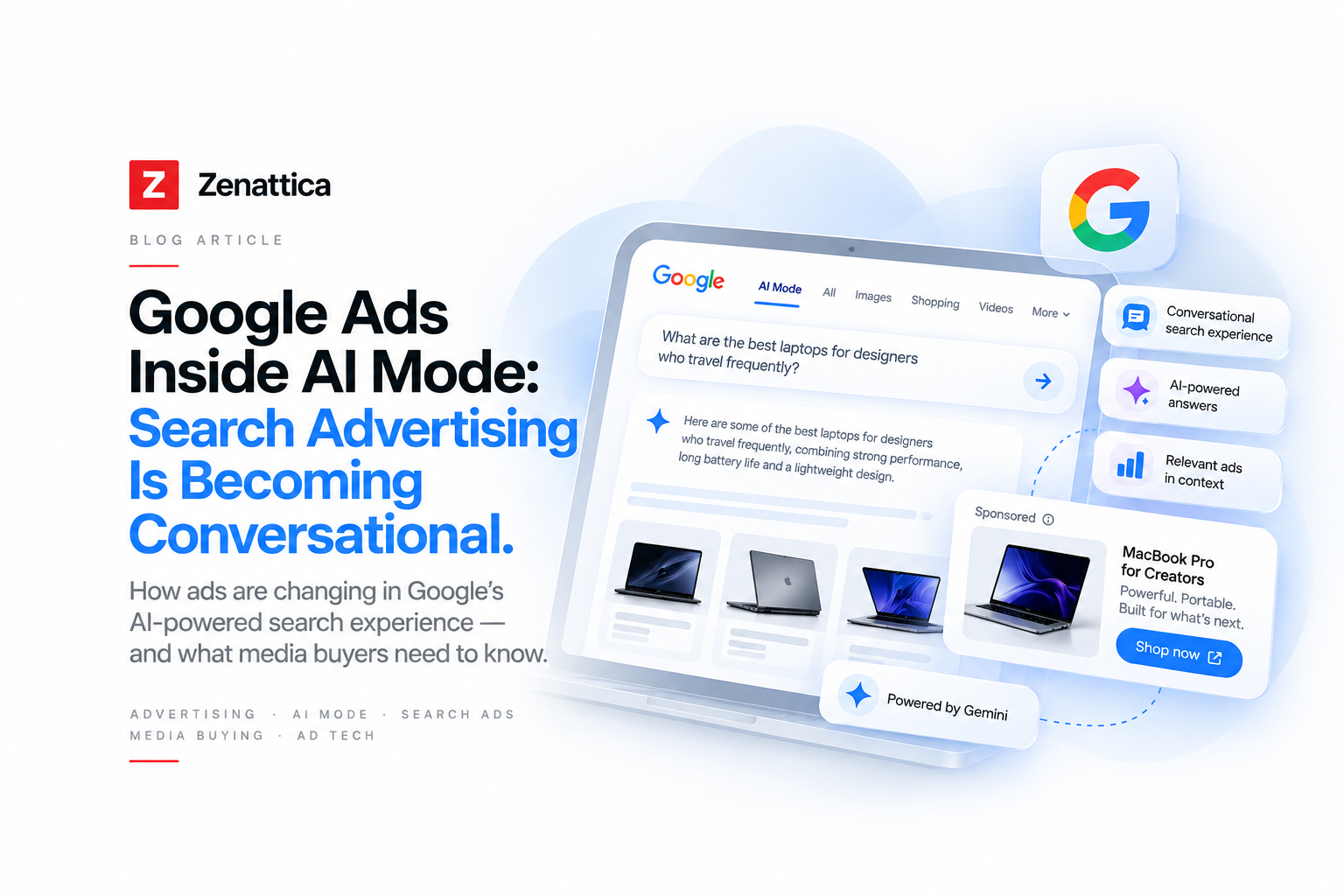

For years, search advertising followed a relatively straightforward model.
A user entered a query.
Google matched that query with relevant keywords, ads and landing pages.
The advertiser competed for the opportunity to appear.
Google’s AI Mode is changing that model.
Instead of returning a traditional page of links and ads, AI Mode is designed to understand complex questions, reason across information and provide a conversational response.
Now Google is bringing advertising directly into that experience.
What is Google AI Mode?
AI Mode is Google’s more conversational search experience, powered by Gemini.
Rather than requiring users to break a complicated question into multiple searches, AI Mode is designed to understand the broader context of what they are trying to accomplish.
That creates a fundamentally different environment for advertising.
A traditional Search ad can be closely associated with a keyword.
An ad inside an AI-generated experience can be associated with a question, context and intent.
And that distinction matters for advertisers.
Google Is Testing Ads Directly Inside AI Mode
Google announced new advertising formats for AI Mode as part of its 2026 advertising updates.
The company says the formats are designed to be integrated into AI-generated responses while remaining clearly labeled as advertising.
They are powered by Google’s Gemini models and connected to AI Max and Performance Max. Google
Google has described several approaches.
Conversational Discovery Ads
These formats are designed to respond to a user’s specific question.
Instead of simply displaying a conventional headline and description, the advertising experience can use AI to highlight information relevant to the particular question being asked.
For example, someone might search for a product based on a very specific need rather than a simple product category.
The advertising experience can then be adapted around that context.
Highlighted Answers
Google has also described ad placements that can appear when AI Mode generates a list of recommendations.
In this scenario, relevant ads can become part of the recommendation experience while remaining identified as sponsored content. blog.google
This is an important change in the relationship between search results and advertising.
The ad doesn’t necessarily have to sit beside an answer.
It can become part of the answer interface itself.
Search Ads Are Also Being Tested in AI Mode
There is another development that may be particularly interesting for PPC specialists.
In September 2026, Google began testing traditional Search ads using exact and phrase match keywords inside AI Mode for queries with clear, direct intent.
This is notable because AI Mode advertising had previously been more closely associated with Google’s AI-powered campaign products. Search Engine Land
If this approach expands, advertisers may not need to think about AI Mode as an entirely separate advertising ecosystem.
Existing Search campaigns could potentially become part of the new conversational environment.
For media buyers, that means understanding the interaction between traditional keyword targeting and Google’s AI-driven interpretation of intent becomes increasingly important.
The Keyword Is No Longer the Whole Story
This may be the biggest change.
Traditional PPC thinking often starts with:
Keyword → Ad → Landing Page
AI-powered Search is moving toward something closer to:
Question → Intent → Context → AI response → Ad → Landing Page
The difference is subtle, but important.
Consider a query such as:
“What’s the best laptop for a designer who travels frequently and needs long battery life?”
That’s not simply a keyword.
It contains:
- a product category;
- a user profile;
- a use case;
- purchasing intent;
- multiple requirements.
An AI-powered search system can interpret those elements together.
For advertisers, this creates opportunities — but it also raises the bar for relevance.
A generic ad may be less useful in an environment where the platform understands the user’s actual question in much greater detail.
Creative Becomes Part of the Signal
Google’s AI Max development is moving toward greater use of AI to match advertising assets with search intent.
That makes the quality and breadth of creative assets increasingly important.
Advertisers may need to provide Google with enough meaningful information to understand:
- what the product does;
- who it is for;
- which problems it solves;
- what makes it different;
- which use cases it supports.
The goal isn’t simply to produce more headlines.
It’s to give the system better material to work with.
Landing Pages Matter Too
The same principle applies after the click.
If an AI system understands a user’s question before showing an ad, the landing page needs to deliver on that promise.
A mismatch can become more obvious.
For example:
User: “Affordable accounting software for a small business”
Ad: “Simple accounting for small teams”
Landing page: generic enterprise software homepage.
The traditional keyword may technically match.
The overall intent does not.
As Search becomes more contextual, consistency between the user’s question, the ad creative and the landing page becomes increasingly important.
Google Is Also Changing Reporting
There is another piece of the puzzle that shouldn’t be overlooked.
On September 23, Google announced a new AI Max reporting feature designed to provide a unified view of the Search advertising journey.
Google says the interface will show which search terms triggered ads, which creative assets were shown and where users landed on the website. blog.google
That’s important because AI-driven advertising can otherwise become difficult to analyze.
When more decisions are automated, advertisers need better visibility into why a campaign generated a particular result.
Reporting becomes just as important as automation.
What This Means for Media Buyers
AI Mode doesn’t eliminate traditional Search advertising.
Instead, it adds another layer of complexity.
Media buyers should pay attention to several areas:
1. Search intent
Think beyond isolated keywords. Understand the questions and problems behind them.
2. Creative coverage
Provide enough variations and meaningful messaging for Google’s systems to identify the right combination for different contexts.
3. Landing-page relevance
Make sure the page actually answers the intent represented by the ad.
4. Campaign structure
Monitor how traditional Search campaigns, AI Max and Performance Max interact with the expanding AI-driven Search inventory.
5. Reporting
Don’t evaluate performance only through top-line CPA or ROAS. As Google’s reporting evolves, use the available data to understand which queries, assets and journeys are actually driving results.
The Bigger Shift
Google Search is gradually moving from a keyword-matching system toward an intent-understanding system.
AI Mode is one of the clearest examples of that transition.
The search engine isn’t only asking:
“What did this person type?”
It’s increasingly trying to understand:
“What is this person actually trying to accomplish?”
And advertising is being built into that process.
For advertisers, this means the fundamentals still matter — targeting, creative, landing pages, measurement and account quality.
But the environment connecting them is changing.
Search is becoming conversational.
And Google Ads is moving with it.
About Zenattica
At Zenattica, we follow changes across Google, Meta, TikTok, Microsoft and other advertising platforms to help media buyers adapt to new account, policy and campaign requirements.
Advertising infrastructure matters when the platform itself keeps changing.

